
Fidelity, BNY, Goldman Sachs, JPMorgan, Morgan Stanley, Citi Lead Strategy’s Bitcoin Banking Adoption
Key Takeaways
- Fidelity led with 71%, followed by BNY at 46% and Goldman Sachs at 45% in Strategy’s new Bitcoin Banking Adoption Index.
- JPMorgan, Morgan Stanley and Citigroup each scored 43%, despite relying on different combinations of bitcoin-related services.
- The other listed institutions scored between 13% and 38%, showing uneven adoption across global banking markets.
How the Six Leaders Separated From the Field
Strategy’s new Bitcoin Banking Adoption Index put overall adoption at 32%, underscoring how unevenly major financial institutions have integrated bitcoin-related services. Fidelity led with 71%, followed by BNY at 46% and Goldman Sachs at 45%, while JPMorgan, Morgan Stanley, and Citigroup each recorded 43%.
Fidelity’s lead reflected one of the broadest bitcoin-related service offerings among the institutions assessed. The company provides direct crypto trading through Fidelity Crypto, institutional custody and execution through Fidelity Digital Assets, and the Fidelity Wise Origin Bitcoin Fund (FBTC), a spot bitcoin exchange-traded fund (ETF). It also serves as custodian for the fund’s bitcoin holdings. Those offerings align with the firm’s leading scores across trading, custody, stablecoins, exchange-traded products, and related categories in Strategy’s index.
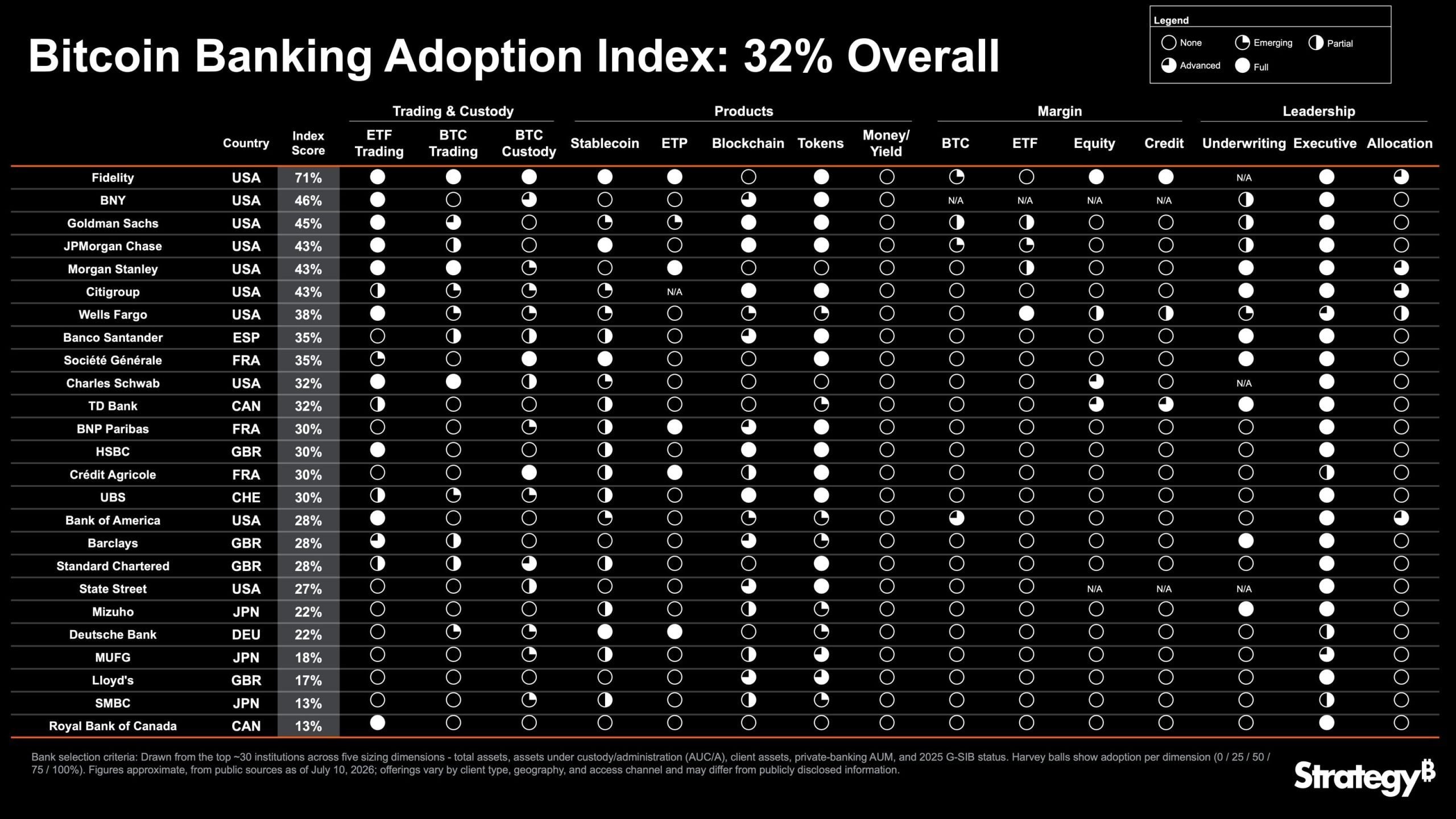
BNY’s second-place finish reflected its emphasis on institutional digital-asset infrastructure. The bank offers crypto custody through its digital asset platform, enabling institutional clients to hold bitcoin and ether alongside traditional assets. The platform also integrates settlement, accounting, and asset-servicing functions. BNY has expanded it to support tokenized assets and on-chain data services, while collaborating with Goldman Sachs to tokenize money market fund records. Those initiatives align with its strong scores in custody, tokens, and executive leadership.
Goldman Sachs’ third-place ranking reflected its growing push into institutional bitcoin investment products. In April, Goldman Sachs Asset Management filed with the U.S. Securities and Exchange Commission (SEC) to launch the Goldman Sachs Bitcoin Premium Income ETF, its first bitcoin ETF. The proposed fund would seek bitcoin exposure while generating income through an options-based strategy. The bank has also expanded its digital-asset platform for tokenized securities and remained active in institutional digital-asset markets, supporting its strong showing in Strategy’s index.
Three Equal Scores Hide Different Banking Strategies
JPMorgan, Morgan Stanley, and Citigroup each scored 43%, though they reached that level through different digital-asset strategies. JPMorgan has focused on institutional payments and tokenization through Kinexys, which offers programmable payments, near-real-time settlement and asset-tokenization services. JPM Coin enables institutional clients to transfer tokenized bank deposits around the clock, while Kinexys Digital Assets supports tokenized money market funds and other financial assets.
Morgan Stanley has emphasized regulated investment products, offering the Morgan Stanley Bitcoin Trust (MSBT), a spot bitcoin ETF, and providing access to bitcoin ETPs through E*TRADE. The firm has also filed with the SEC to launch the Morgan Stanley Ethereum Trust (MSSE) and the Morgan Stanley Solana Trust, both of which remain subject to regulatory approval. Those initiatives align with its strengths in bitcoin trading, exchange-traded products, and institutional investment access identified in Strategy’s index.
Citigroup has centered its strategy on institutional payments and digital-asset infrastructure through Citi Token Services, which uses tokenized commercial bank deposits and smart contracts for 24/7 cross-border payments, liquidity transfers, and trade finance. The bank has also developed digital-asset custody capabilities and the Citi Integrated Digital Assets Platform. That platform connects its work across digital money, securities, custody, asset servicing, and collateral mobility.
How the Remaining 19 Institutions Ranked
Wells Fargo led the rest of the field at 38%, followed by Banco Santander and Société Générale at 35%. Charles Schwab and TD Bank scored 32%, while BNP Paribas, HSBC, Crédit Agricole, and UBS each received 30%. Their profiles generally concentrated on selected trading, blockchain, token, underwriting, or leadership categories.
Bank of America, Barclays, and Standard Chartered each scored 28%, with State Street at 27%. Mizuho and Deutsche Bank recorded 22%, MUFG scored 18%, and Lloyd’s reached 17%. SMBC and Royal Bank of Canada shared the lowest score at 13%.
What the Index Still Cannot Show
The rankings indicate whether capabilities are publicly visible, but they do not measure customer numbers, transaction volumes, assets, revenue or profitability. A service may also be limited to institutional or wealth-management clients, or restricted to particular geographic markets. A high adoption score therefore does not necessarily show how widely each product is available or how extensively customers use it.
Future custody launches, lending products, customer-access disclosures, and corporate bitcoin allocations could change the order of the ranking. For now, Fidelity holds a substantial lead, while BNY, Goldman Sachs, JPMorgan, Morgan Stanley and Citigroup are separated by only three percentage points. Further disclosures could clarify whether those banks are moving toward Fidelity’s broader model or maintaining more specialized digital-asset strategies.