
The cryptocurrency market has entered “extreme greed” for the first time since late 2024, with CoinMarketCap’s sentiment index reaching 81 after Bitcoin gained about 24% in seven days.
Summary
- CoinMarketCap’s Fear and Greed Index rose from 41 to 81 within one week.
- The reading has climbed 45 points from its level of 36 one month ago.
- Bitcoin’s weekly rally coincided with heavy short liquidations and renewed U.S. ETF demand.
- Alternative.me’s separate index remains in greed, showing differences between the two methodologies.
Crypto Fear and Greed Index reaches 81
CoinMarketCap’s Fear and Greed Index registered 81 late on Aug. 24 and remained at the same level the following day, placing cryptocurrency sentiment in its “extreme greed” category.
One week earlier, the gauge stood at 41, while its reading a month ago was 36. The latest figure represents a 40-point increase over seven days and a 45-point rise across the month, reversing the caution seen during much of the first half of 2026.
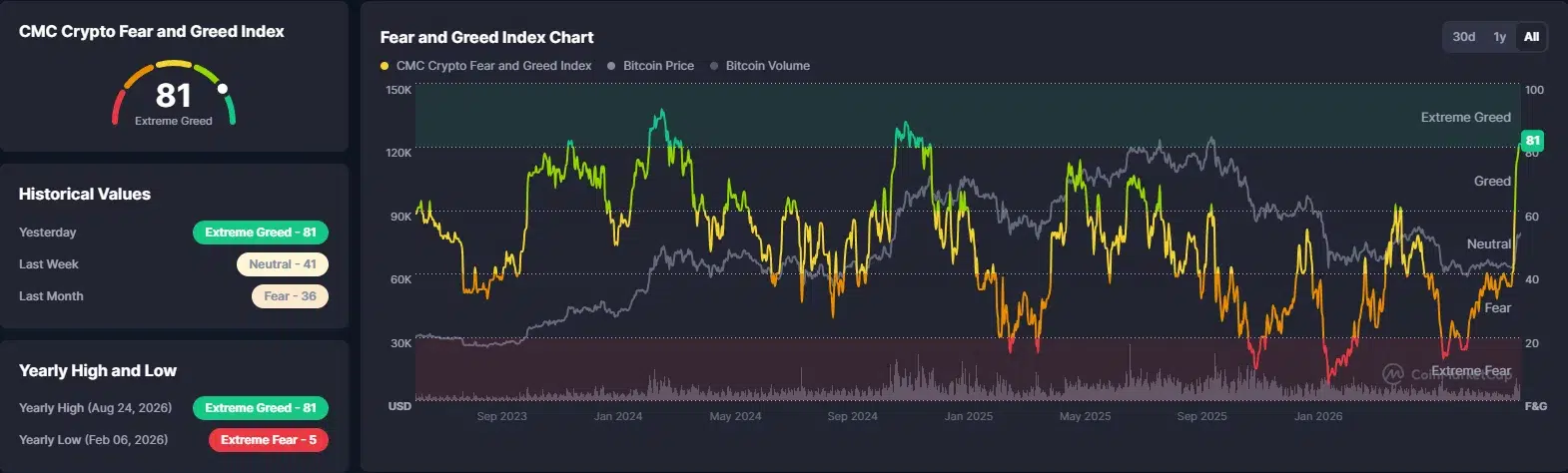
Extreme greed begins at 80 under CoinMarketCap’s classification. A reading above that threshold points to strong buying interest and high confidence, although the platform says elevated sentiment may also indicate that the market is overheated and vulnerable to a correction.
CoinMarketCap builds the index from five groups of data: price momentum, volatility, derivatives activity, market composition, and its own social and engagement information. Price performance covers the 10 largest non-stablecoin cryptocurrencies, while the derivatives component includes put-to-call ratios for Bitcoin and Ethereum options.
The methodology also uses Bitcoin’s value relative to stablecoin supply, along with searches and user activity recorded by the platform. Since each input reacts differently to changing market conditions, the reading does not measure price performance alone.
February offered the opposite picture. The index fell to 5 on Feb. 5, its lowest point of 2026 and a level associated with extreme fear. Its advance from 5 to 81 has carried the gauge from its most bearish category to its most bullish one in less than seven months.
As reported in July, Bitcoin traded near $58,000 to $60,000 while sentiment readings sat in the low teens. At the time, spot Bitcoin exchange-traded funds had recorded $4.5 billion in June outflows, and aggregate crypto open interest had fallen from more than $90 billion to about $44.5 billion.
Bitcoin’s 24% rally drives the sentiment jump
Bitcoin supplied much of the price momentum behind the latest reading, climbing about 24% over the week and briefly moving above $80,000 for the first time since May. The cryptocurrency traded near $79,000 on Aug. 25 after easing from an intraday high around $81,255.
CoinMarketCap said Bitcoin rose 24% as its sentiment reading moved from 41 to 81. The platform also placed the total cryptocurrency market value at about $2.67 trillion on Aug. 24, up 23.8% over seven days.
Even with gains across several large cryptocurrencies, Bitcoin retained close to 60% of the market’s total value. CoinMarketCap placed its dominance at approximately 59.7% on Aug. 26, indicating that the largest cryptocurrency continued to account for most of the sector’s capitalization.
The rally began after Bitcoin broke out of a trading range near $62,000 to $65,000 on Aug. 19. As the price passed $70,000, traders holding leveraged bearish positions had to buy back Bitcoin to close their trades, adding forced demand to the advance.
According to CoinGlass figures cited in coverage of the squeeze, approximately $2.7 billion in bearish crypto positions were liquidated over 24 hours. More than $1 billion of Bitcoin shorts closed within about one hour, while short trades accounted for about 92% of nearly $3 billion in total liquidations across more than 172,000 traders.
Liquidation figures differ depending on the reporting period. Estimates covering the full two-to-three-day advance placed total crypto short liquidations above $4 billion, whereas the $2.7 billion figure covered the main 24-hour breakout through $70,000.
Treasury buybacks preceded the Bitcoin breakout
The U.S. Treasury announced on Aug. 19 that it would at least double the maximum size of liquidity-support buybacks for 10-to-20-year and 20-to-30-year nominal coupon securities.
Beginning Sept. 9, the purchase cap will increase from $2 billion to at least $4 billion per operation. Treasury said the adjustment is intended to improve liquidity in longer-dated government debt, where older securities can become harder for dealers to trade.
Bond yields and the U.S. dollar weakened after the announcement, while Bitcoin rose from an intraday low near $64,100 to roughly $69,500 within 12 hours. The 30-year Treasury yield fell from a 19-year high above 5.34% to about 5.19%, and the 10-year yield declined to 4.647%.
As crypto.news previously detailed, the buyback increase does not take effect until September, meaning no money from the expanded operations had entered the market when Bitcoin began climbing. Treasury buybacks also differ from Federal Reserve quantitative easing because the department funds the purchases through debt issuance rather than creating central-bank reserves.
Market participants still linked the announcement to easier financial conditions, lower long-term yields, and the subsequent demand for risk assets. Treasury has not said that its program was designed to support Bitcoin, nor has it established that the buyback decision directly caused the cryptocurrency’s rally.
The distinction matters for U.S. investors because Treasury yields affect the returns available from government debt. When bond yields fall, investors may allocate more capital to stocks, commodities and cryptocurrencies, but Bitcoin remains exposed to sharp price changes even when macro conditions appear supportive.
U.S. Bitcoin ETFs add spot demand
U.S.-listed spot Bitcoin ETFs recorded about $517 million in net inflows on Aug. 19, followed by approximately $606 million on Aug. 20, according to SoSoValue data. The two sessions brought more than $1.1 billion into the funds as Bitcoin moved through $70,000 and $75,000.
Across the five trading days ending Aug. 21, the products attracted approximately $1.9 billion. The inflows gave American investors more Bitcoin exposure through regulated brokerage and retirement accounts without requiring them to hold the asset directly.
Spot Ether ETFs added about $221 million on Aug. 20, while XRP and Solana investment products received approximately $13 million and $15 million, respectively. Combined flows into Bitcoin and Ether funds reached roughly $2.3 billion during the rally period.
Analysts interviewed for a Bitcoin demand assessment said continued ETF and cash-market purchases would be needed after short covering faded. Nansen senior research analyst Nicolai Søndergaard described the price action as an improvement in market structure but said it did not yet confirm that the full market cycle had turned.
Bitget Wallet research analyst Lacie Zhang also attributed the advance to a mix of ETF purchases, macro conditions, and forced buying from bearish traders. She said fresh spot demand would need to continue for Bitcoin to remain above $80,000 after the squeeze ended.
Alternative.me records a less extreme reading
Alternative.me’s sentiment gauge remained in the “greed” category rather than extreme greed, sitting about six points below its own extreme threshold when the CoinMarketCap reading reached 81.
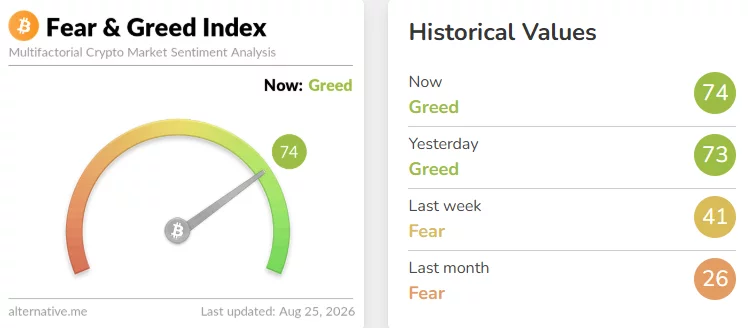
The difference comes from separate inputs and scoring methods. Alternative.me’s index focuses mainly on Bitcoin and uses volatility, market momentum and volume, social-media activity, Bitcoin dominance and Google search trends.
Volatility and market momentum each carry a 25% weighting. Bitcoin dominance accounts for 10%, while search trends contribute another 10%. The service lists surveys as a 15% component but says polling is currently paused.
Alternative.me says rising Bitcoin dominance can indicate that traders are moving away from more speculative tokens, which its model may interpret as fear rather than greed. CoinMarketCap instead measures conditions across the 10 largest non-stablecoin cryptocurrencies and includes Bitcoin and Ethereum options data.
Both gauges nonetheless recorded a rapid improvement in sentiment as Bitcoin recovered from its midyear lows. Alternative.me says its index should not be treated as investment advice and warns that excessive greed can precede a market correction.