Key Takeaways
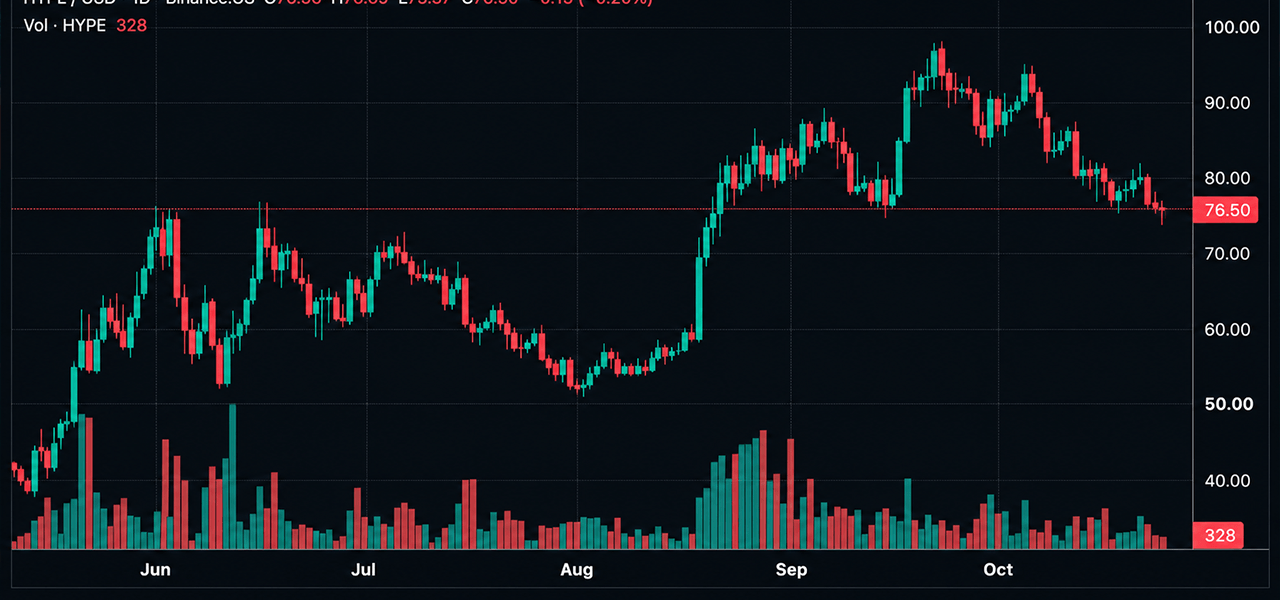
- Hyperliquid’s HYPE trades 22% below its September record despite commanding $11 billion in open interest.
- Hyperliquid’s RWA perpetuals market share has fallen from approximately 80% to 26%.
- HYPE buybacks face mounting pressure from token unlocks, declining volumes and rival exchanges.
Hyperliquid Still Rules Perpetual Trading, but HYPE’s Crown Is Slipping
Hyperliquid has a peculiar problem: Its trading platform remains the dominant decentralized perpetual futures exchange, yet its native HYPE token is trading roughly 22% below its all-time high. On Oct. 25, 2026, HYPE’s price hovered around $76 to $77, well beneath its Sept. 23 peak near $98.
The question now gripping traders is whether Hyperliquid’s billion-dollar revenue machinery can overpower intensifying competition, cooling derivatives activity, and a steady stream of new tokens entering circulation.
A $17 Billion Token With a Billion-Dollar Engine
Hyperliquid operates a purpose-built, layer one (L1) blockchain supporting perpetual futures and spot trading through a decentralized exchange (DEX). Unlike platforms that rely primarily on speculative token demand, Hyperliquid directs most net protocol fees toward purchasing HYPE through its Assistance Fund.
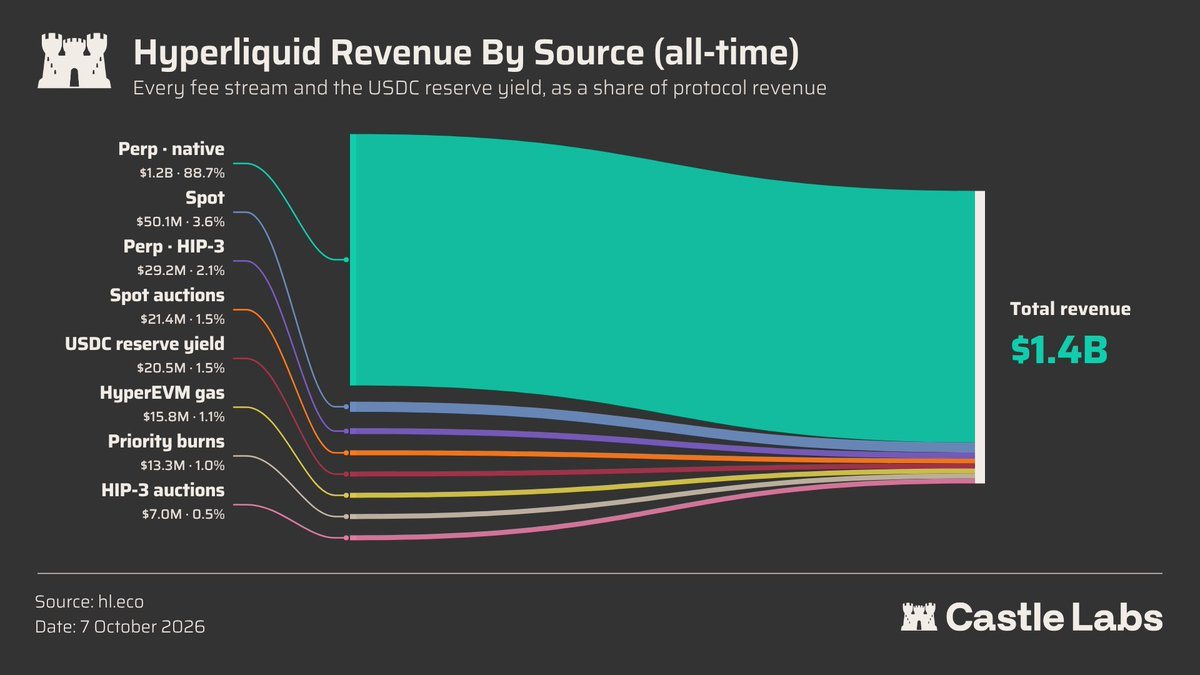
The numbers pack a punch. Cumulative protocol revenue, according to the research and advisory firm Castle Labs, exceeded $1.4 billion, with approximately 97% to 99% of eligible net fees historically supporting token purchases. Roughly 48 million HYPE have been associated with the fund, while reserve yields provide another source of purchasing power.
HYPE’s 24-hour trading volume recently ranged between $4.6 billion and $7.3 billion, while 30-day volume approached $200 billion to $209 billion. Coinglass.com logs show $11 billion in cumulative open interest on Hyperliquid over the last day. That leaves Hyperliquid sitting pretty atop the decentralized perpetual futures business, commanding an estimated 55% to 57% of tracked open interest. Alongside this, over the weekend, HYPE stands as the tenth largest crypto asset by market cap today with $19.38 billion.
Rivals Muscle In as the Perpetual Futures Boom Cools
But competition is throwing cold water on the growth narrative. Hyperliquid’s share of real-world asset (RWA) perpetual futures volume reportedly collapsed from approximately 80% in July to 26% in recent measurements. Centralized exchange (CEX) platforms collectively captured around 64%, with Binance, OKX, and other established operators expanding into tokenized equities and commodities. Decentralized competitors, including Lighter, Aster, and Variational, are also chasing trading volume with increasingly similar products and fee structures.
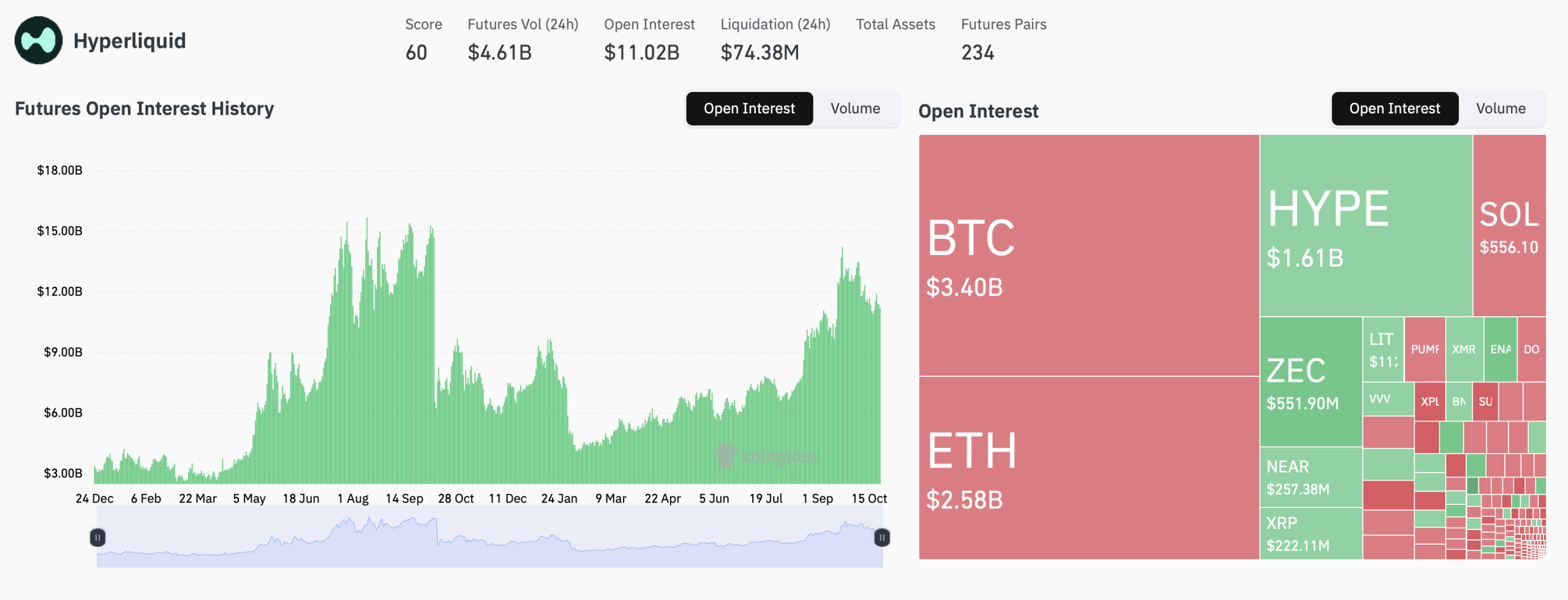
The broader sector has cooled considerably. The retreat reflects reduced leverage, fading trading incentives, and diminished speculative appetite following an exceptionally active 2025. Bitmex co-founder Arthur Hayes has also questioned whether HYPE can outperform competing crypto assets as the trade becomes increasingly crowded. Compounding these concerns, some critics have dismissed Hyperliquid’s foray into prediction markets as a disappointing “flop.”
Token Unlocks Threaten to Outrun Buybacks
Perhaps the biggest complication sits inside HYPE’s supply schedule. Core contributors control an allocation representing approximately 23.8% of maximum supply, with vesting extending into 2027 and 2028. Some monthly schedules indicate releases approaching 9 million to 10 million tokens, although actual distributions and immediately tradable amounts can differ.
With only about 22% of HYPE’s maximum supply circulating, future dilution remains a substantial consideration. Hyperliquid’s buybacks create persistent demand, but those purchases depend heavily on trading activity. Lower volume means fewer fees, fewer repurchases and potentially more difficulty absorbing newly released tokens.
Can Hyperliquid’s Next Act Defend Its Valuation?
The bulls aren’t folding their cards. Hyperliquid still commands a majority of tracked decentralized perpetual futures open interest, while newer businesses involving real-world assets, prediction markets, HyperEVM and developer infrastructure offer potential revenue beyond cryptocurrency derivatives.
Institutional participation provides another counterweight. Spot HYPE exchange-traded funds (ETFs) and publicly traded treasury vehicles have expanded access, with Hyperliquid Strategies reportedly holding tens of millions of tokens. Cumulative net inflows for the three current HYPE ETFs stand at $303.5 million according to sosovalue.com records.
For HYPE, the contest is no longer simply about attracting traders. It’s about generating enough sustained revenue to offset dilution while defending market share against competitors with enormous distribution advantages. A protocol can remain the industry’s biggest trading venue and still discover that its token was priced for an even bigger future.
What comes next is anyone’s guess, but in the crypto world, unpredictability is practically the only certainty.