Key Takeaways
- Arkham Intelligence flags Roswell, NM, holding 0.173 BTC worth $13,000 onchain as of May 26, 2026.
- The City of Roswell launched the first known U.S. municipal bitcoin reserve in April 2025 via donations.
- Mayor Pro Tem Juliana Halvorson signed a ceremonial receipt, setting a ten-year BTC holding mandate.
City of Roswell, NM Sits on $13,000 in BTC as Arkham Tracks It Onchain
The post, framed as a tongue-in-cheek joke tying the city’s famous 1947 UFO incident to its bitcoin reserve, is not a factual claim about extraterrestrial ownership. Arkham made clear through its humor that the holdings belong to the city government.
The post read: “ALIENS ARE BUYING BITCOIN,” referencing Roswell’s storied UFO history before pivoting to the real data point: a small but symbolically significant municipal bitcoin reserve. As of publication, the post had collected roughly 81,000 views, 810 likes, and 149 replies, with comments filled with alien memes and crypto jokes.
Arkham followed up immediately with a direct link to the City of Roswell entity page on its platform, where anyone can monitor the holdings onchain. The explorer flags the wallet under the official “City of Roswell” label, complete with an alien-themed avatar. The dashboard shows a holdings history chart, inflow transactions, and linked bitcoin address tied to the city’s reserve. The data is publicly verifiable.
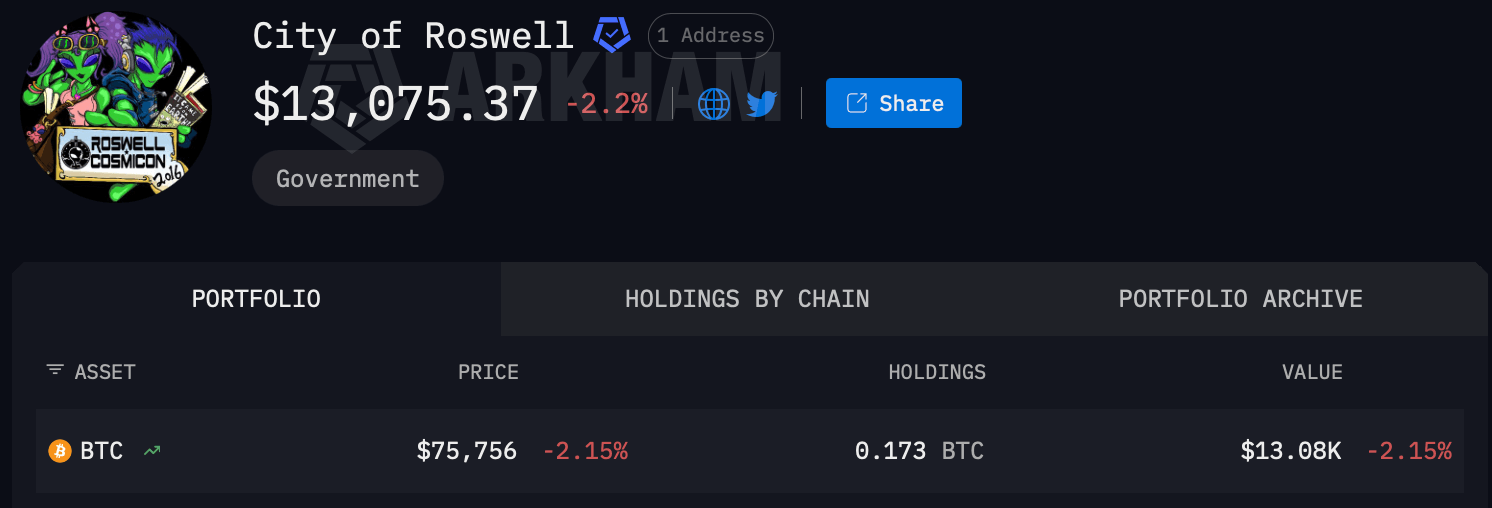
The holdings trace back to an initiative the city formally launched in 2025. Roswell accepted an anonymous donation of roughly 0.0305 BTC, worth approximately $2,900 to $3,000 at the time. Additional donations arrived over the following months, pushing the total past $5,000 in value before reaching today’s level of just above $13,000. Mayor Pro Tem Juliana Halvorson signed a ceremonial receipt acknowledging the initial gift, making it an official part of the city’s treasury.
City officials structured the reserve with a defined long-term strategy. bitcoin holdings carry a mandatory ten-year holding period before primary use, treating the asset as a store of value rather than operational funds. Once the reserve reaches a $1 million target, proceeds are earmarked primarily for senior citizens, including water bill subsidies, and for disaster relief or emergency funds. The city council can access up to 21% of holdings every five years for declared disasters, requiring unanimous approval.
Roswell positioned itself as a first mover among U.S. municipalities holding bitcoin as a treasury asset. The move drew attention in bitcoin communities and media as a potential model for other local governments exploring crypto on their balance sheets. The city that inspired Arkham’s meme has carried the weight of UFO mythology for nearly eight decades.
The History of the Infamous Roswell Incident
In the summer of 1947, rancher W.W. “Mac” Brazel discovered unusual debris on his property near Corona, about 75 miles northwest of Roswell. The material included metallic sticks, foil, rubber strips, and paper-like fragments. The Roswell Army Air Field responded quickly, and on July 8, 1947, the Roswell Daily Record ran a headline announcing authorities had “captured a flying saucer.”
The military retracted the statement within days, attributing the debris to a weather balloon. Decades later, a 1994 U.S. Air Force report linked the wreckage to Project Mogul, a classified program deploying high-altitude balloons to monitor Soviet nuclear tests. Later reports suggested alleged “alien bodies” from witness accounts were likely anthropomorphic test dummies used in high-altitude experiments during the 1950s.
The official explanations did little to quiet the story. Books like “The Roswell Incident,” published in 1980, codified the incident as one of the most enduring pieces of American UFO folklore. Claims of a recovered alien spacecraft, grey alien bodies, government cover-ups, and reverse-engineered technology spread across decades of books, documentaries, and television. Programs like “The X-Files” drew directly from the Roswell mythology, cementing the city’s identity in popular culture.
Several factors kept the story alive. The initial military announcement of a flying disc created immediate worldwide attention before the retraction arrived. The Cold War climate made classified government programs easy to reframe as evidence of secrecy. Early 1947 also saw a wave of flying saucer sightings across the United States, giving the Roswell case cultural momentum from the start.
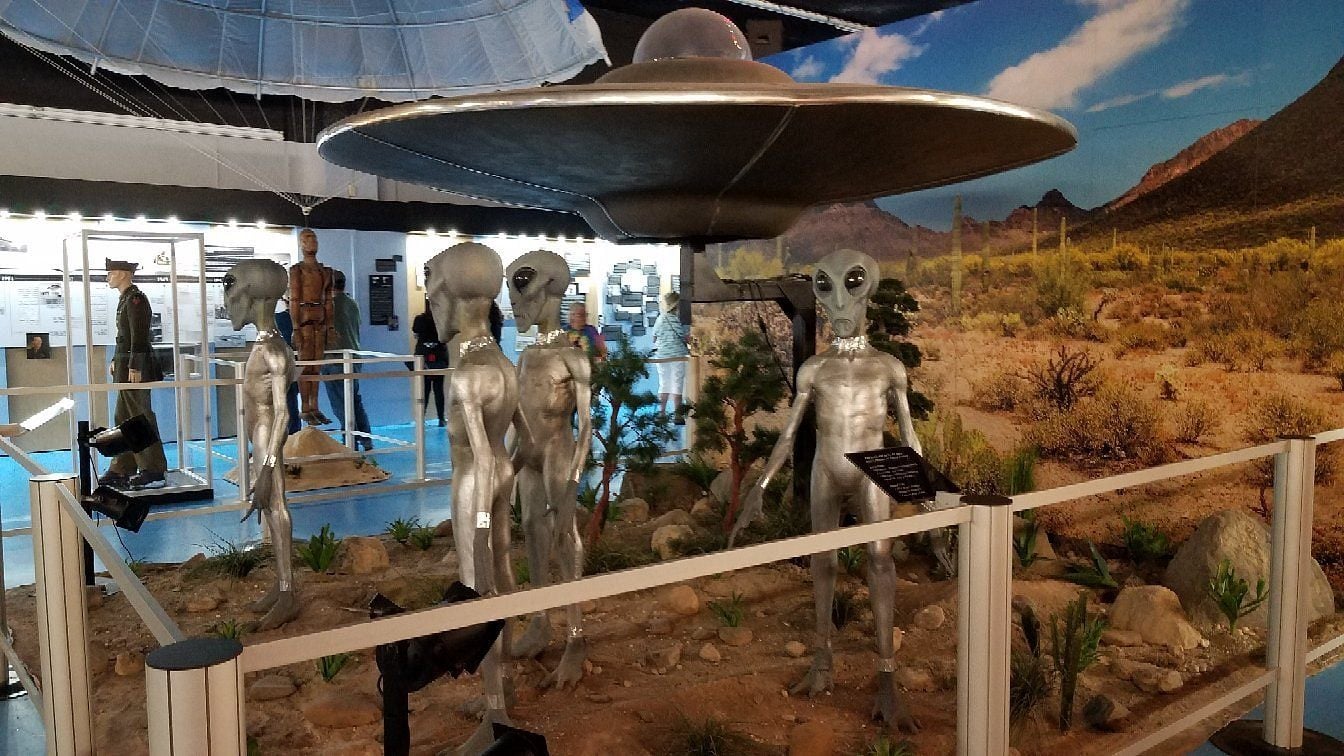
Roswell leaned into the lore deliberately. The International UFO Museum and Research Center opened in 1992 and draws visitors year-round. The annual Roswell UFO Festival, running since 1996, brings parades, costumes, lectures, and thousands of attendees each summer. The city’s streets feature alien-shaped streetlights, murals, and statues. A local McDonald’s is built in the shape of a flying saucer. Gift shops selling grey alien merchandise line the main drag. Tourism built around the 1947 incident became a central part of the local economy.
Arkham’s meme lands squarely in that tradition. The platform attached a black-and-white close-up photograph of the stereotypical large-eyed grey aliens, paired with a network visualizer showing onchain connections flowing to Roswell’s bitcoin wallet. The joke works because the underlying data is real and publicly accessible through Arkham’s blockchain explorer. The city holds bitcoin. Anyone can verify it.
Whether other small cities follow Roswell’s model remains to be seen, but the city’s ten-year holding mandate and defined spending rules give the reserve more structure than most observers expected from a municipality better known for green alien statues than government finance.