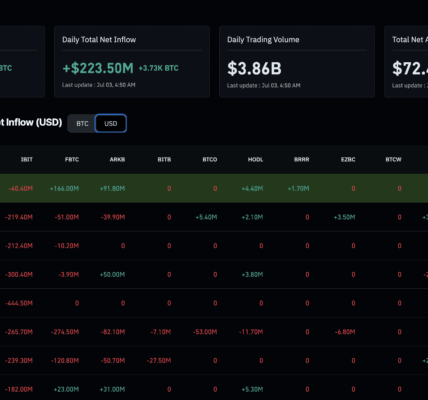
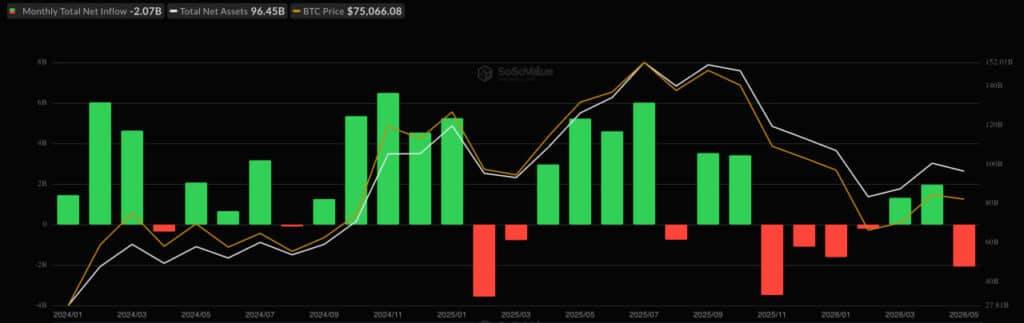
Bitcoin ETF News: BlackRock’s iShares Bitcoin Trust has accumulated roughly $56 billion in cumulative inflows since its January 2024 launch, making it one of the fastest-growing ETF products in financial history, and the default entry point for a new generation of Bitcoin investors who have never touched a crypto exchange.
Spot Bitcoin ETF funds collectively now hold close to 1.3 million BTC, representing nearly 7% of all Bitcoin in circulation, with IBIT commanding the dominant share of that exposure.
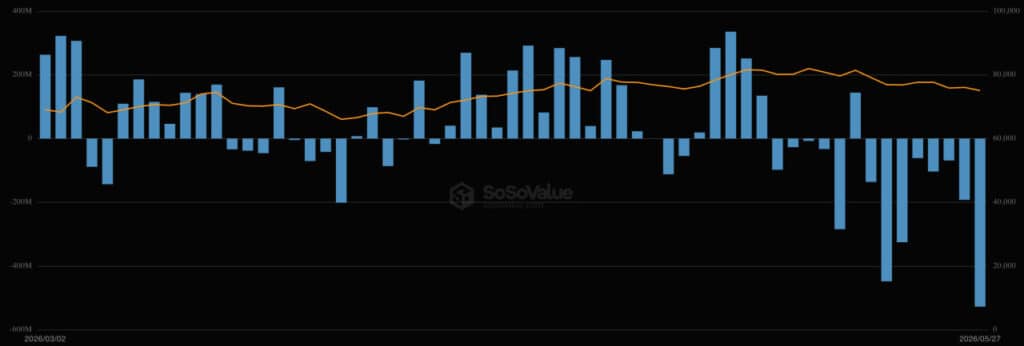
So, if IBIT is so popular with beginners, why did $527.84 million leave the fund in a single day in May, and does that outflow mean the on-ramp is closing? The short answer is no.
Understanding why requires a quick look at how IBIT actually works, who’s really been selling, and what that means for someone just getting started with crypto for beginners.
DISCOVER: Best Meme Coin ICOs to Invest in 2026
Bitcoin ETF News: BlackRock IBIT Explained, What the $56 Billion Number Actually Tells You
Think of IBIT like a storage facility that holds Bitcoin on your behalf. You don’t get a key to a specific locker, you get a receipt (a share) that says you own a proportional slice of everything stored inside. When you want out, you hand back the receipt and get cash. You never touched the Bitcoin directly, and you never needed to.
That is exactly how BlackRock’s Bitcoin ETF works in practice. When you buy a share of IBIT through a brokerage like Fidelity or Schwab, BlackRock purchases the equivalent amount of actual Bitcoin and holds it in custody. Your brokerage account shows an IBIT position just like it would show a share of Apple or a bond fund.
In plain English: you get Bitcoin price exposure without ever creating a wallet, managing a private key, or worrying about which exchange to trust.
The $56 billion cumulative inflow figure tells you that an enormous amount of capital, from retirement accounts, financial advisors, and institutional portfolios, has already decided this is the preferred format.
As our explainer on Bitcoin ETF flows walks through, the ETF structure solves a real problem: it lets investors access Bitcoin’s price performance through the same regulated, familiar infrastructure they already use for every other investment.
Now, about that $527.84 million outflow. According to data from SoSoValue, that single-day redemption was IBIT’s second-worst on record, alarming on its face. But set against $56 billion in cumulative inflows, it represents less than 1% of the total capital that has flowed into the fund since launch. For beginners, that context matters enormously before reacting to any headline number.
DISCOVER: IBIT’s worst days explained, what beginners actually need to know
Why IBIT Specifically: The On-Ramp Advantages Crypto Exchanges Can’t Match
The May outflow wave had very little to do with Bitcoin itself. April’s Producer Price Index came in at 6% year-over-year – significantly hotter than the analyst estimate of 3.8% and the highest reading in over two years.
That single inflation print caused June rate-cut odds on the CME FedWatch tool to drop from around 62% to around 38% almost overnight. Macro funds that had positioned in IBIT as a rate-sensitive trade simply reversed course using the same convenient exit ramp they used to enter.
As one analyst put it: “Institutions didn’t reach a new verdict on Bitcoin. They reached a new verdict on the Fed, and Bitcoin happened to be sitting in the rate bucket.” That distinction is critical for beginners to internalize, institutional bitcoin adoption through IBIT moves with macro conditions, not just Bitcoin sentiment.
This is precisely why IBIT is structured as the dominant tool for that institutional activity. When a macro fund needs to exit a position fast, IBIT offers equity-like execution: tight bid-ask spreads often measured in cents, daily trading volumes frequently in the billions of dollars, and standard equity clearing and settlement.
No wallets, no blockchain confirmation times, no exchange withdrawal queues. Bloomberg ETF analyst Eric Balchunas has consistently described IBIT as “the new default way for tradfi to own bitcoin,” noting that its volume and flow patterns resemble a major equity index fund rather than a crypto-native product.
For beginners specifically, the advantages stack up differently. BlackRock is the world’s largest asset manager, overseeing more than $10 trillion in assets globally. a brand that carries institutional-grade trust for investors who might be deeply uncomfortable navigating Coinbase or Binance for the first time.
IBIT charges a 0.25% annual sponsor fee, which for many investors is lower than the combined trading and withdrawal costs of retail crypto exchanges. And critically, IBIT is available inside IRAs and tax-advantaged accounts through major wirehouses, a use case that is practically impossible with self-custody Bitcoin on an exchange.
As covered in our analysis of recent IBIT outflow trends, the fund’s periods of selling have consistently been driven by macro positioning shifts rather than any loss of confidence in the ETF structure itself. The on-ramp isn’t closing, it’s just experiencing the same rate-sensitivity that affects every risk asset when inflation surprises to the upside.
DISCOVER: The Next 1000x Crypto Gem Before It Lists on Binance
The post Bitcoin ETF News: Why Beginners Are Choosing BlackRock Over Crypto Exchanges appeared first on 99Bitcoins.