
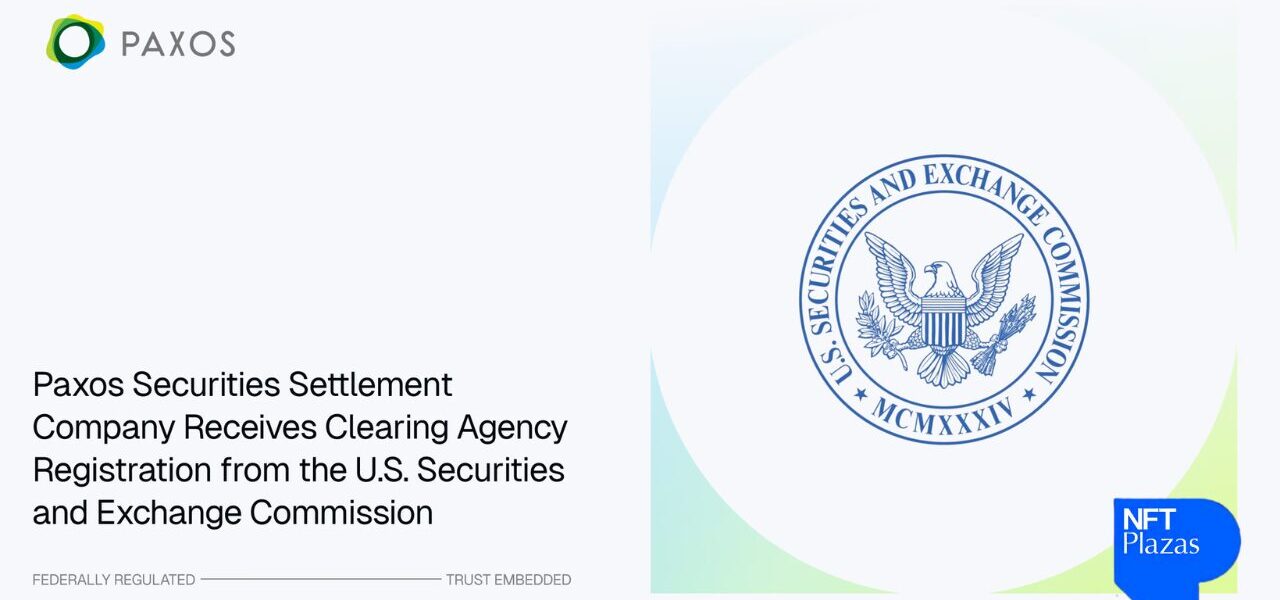
The landmark registration makes the stablecoin issuer the first blockchain-native firm authorized as a central securities depository for U.S. equities, setting up a direct challenge to the DTCC’s post-trade dominance.
In a milestone that crypto advocates and Wall Street reformers have anticipated for years, Paxos has secured federal authorization to operate as a clearing and settlement provider for U.S. equities using blockchain technology — a development that could fundamentally rewire the plumbing behind American securities markets.
Paxos Securities Settlement Company, LLC (PSSC), a subsidiary of the stablecoin and blockchain infrastructure firm Paxos, has been granted registration as a clearing agency by the U.S. Securities and Exchange Commission under Section 17A of the Securities Exchange Act of 1934. The approval positions PSSC as the first blockchain-native firm authorized to operate as a central securities depository (CSD) for traditional equities in the United States — placing it in the same regulatory category as the Depository Trust & Clearing Corporation, the entrenched post-trade giant that has processed the vast majority of U.S. securities settlements for decades.
Seven Years in the Making
The approval did not arrive overnight. CEO and co-founder Charles Cascarilla described it as “the result of seven years of work with the SEC,” tracing the journey back to a 2019 no-action letter that gave Paxos permission to begin developing a live settlement pilot.
That pilot launched in February 2020, allowing Paxos to clear and settle U.S. equities daily with the participation of some of the world’s largest financial institutions, including Bank of America, Credit Suisse and Societe Generale. The live pilot served as a proof of concept, demonstrating that blockchain-based infrastructure could support same-day settlement within a regulated framework while lowering operational costs.
While the SEC’s order technically describes the current registration as temporary, the milestone still places Paxos in a rare category: a crypto-native firm operating inside the regulated infrastructure of U.S. securities markets rather than orbiting around it.

Paxos CEO Charles Cascarilla
What Blockchain Settlement Actually Means
To understand why this matters, it helps to appreciate just how slow traditional settlement infrastructure is relative to the trades it supports.
In today’s equity markets, a stock trade can execute in milliseconds. But the actual legal transfer of ownership — the settlement — has historically lagged far behind. For decades, U.S. markets operated on a T+2 cycle, meaning trades settled two business days after execution. The industry upgraded to T+1 in 2024, cutting the lag by half, but the underlying infrastructure still involves centralized clearing houses, layered intermediaries, trapped collateral and meaningful counterparty risk during the settlement window.
Paxos argues that blockchain eliminates these structural delays entirely. By using a distributed ledger as the clearing rail, PSSC can settle eligible securities on a same-day basis or near-instantly, freeing up capital that institutional participants currently have locked during settlement periods. Rather than layering onto legacy infrastructure, PSSC can bypass it.

Paxos Wins SEC Approval to Clear U.S. Stocks on Blockchain
A Platform Play for Institutional Finance
The timing of the approval is strategically significant. Tokenized securities, on-chain settlement tools and stablecoins have steadily migrated from the edges of capital markets conversation toward its center. Major banks, asset managers and market infrastructure providers are now actively building or exploring blockchain-based post-trade solutions, and regulatory clarity has been one of the primary obstacles to broader adoption.
Paxos already holds licenses from the Office of the Comptroller of the Currency in the U.S., Singapore’s Monetary Authority and Europe’s FIN-FSA. The SEC’s clearing agency registration adds another regulated credential to a platform that has already attracted significant institutional partners, including PayPal, Mastercard and Interactive Brokers, which use Paxos’ white-label infrastructure tools.
With the CSD designation, Paxos can now bundle regulated stock clearing directly with those existing infrastructure offerings — a potentially compelling proposition for traditional finance firms looking to modernize their post-trade operations without building from scratch.
Challenging DTCC’s Decades-Long Hold
The DTCC processes tens of trillions of dollars in securities transactions annually and has operated as the de facto backbone of U.S. post-trade infrastructure for generations. Displacing or meaningfully competing with that kind of entrenched institution is not a short-term undertaking, and Paxos has been careful not to frame its approval as a declaration of war.
But the structural advantages of blockchain settlement — speed, capital efficiency, reduced counterparty risk and lower operational overhead — represent a genuine value proposition for the institutional participants who currently absorb the costs of legacy infrastructure. As those participants grow more comfortable with digital asset technology and regulatory frameworks continue to mature, the case for on-chain settlement becomes harder to dismiss.
For Paxos, the SEC registration transforms a years-long regulatory effort into a commercially actionable business. The firm now holds a regulated opening into one of the most consequential layers behind global securities trading — and for the first time, it has the federal authorization to use it.
Disclaimer NFTPlazas provides trusted news and insights on Web3. The views expressed on this site do not constitute investment advice. Before making any high-risk investments in cryptocurrency or digital assets, please conduct your own thorough research. All transfers and transactions are carried out at your own risk, and any resulting losses are solely your responsibility. NFTPlazas does not endorse the buying or selling of cryptocurrencies or digital assets and is not a licensed investment advisor. Please also note that NFTPlazas may participate in affiliate marketing programs.