
SoftBank Group shares have plunged more than 12% after reports suggested OpenAI is considering delaying its planned initial public offering until 2027 to preserve a potential valuation of up to $1 trillion.
Summary
- SoftBank shares fell 12.5% after reports suggested OpenAI may delay its IPO until 2027.
- OpenAI is reportedly weighing a lower-valued IPO this year against pursuing a $1 trillion valuation later.
- SoftBank’s $64.6 billion OpenAI commitment has made its stock increasingly sensitive to the startup’s listing plans.
According to reports, SoftBank shares dropped as much as 13% during trading in Tokyo on Friday before closing 12.53% lower, making the investment conglomerate one of the biggest contributors to the Nikkei 225’s roughly 4% decline.
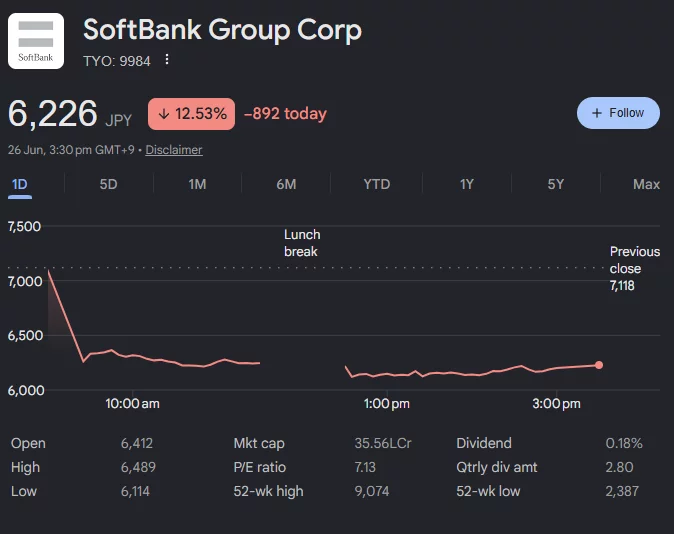
The selloff followed reports that OpenAI executives are weighing whether to proceed with a lower-valued IPO this year or postpone the listing until 2027 while continuing to pursue a valuation approaching $1 trillion.
Reports indicated that OpenAI chief executive Sam Altman opposed reducing the company’s valuation simply to accelerate a stock market debut. Although the company confidentially filed a draft registration statement with the U.S. Securities and Exchange Commission earlier this month, OpenAI said at the time that no final decision had been made on the timing of an IPO and that it could remain privately held for longer.
OpenAI’s expanding business has increased investor focus
Pressure on SoftBank has intensified because of its growing financial commitment to OpenAI. The Japanese investment group agreed in February to invest another $30 billion into the artificial intelligence company. Once completed, the transaction will raise SoftBank’s total commitment to about $64.6 billion and give it an ownership stake of roughly 13%.
Because of that exposure, investors have increasingly treated SoftBank as one of the largest public proxies for OpenAI’s future value. A later public listing would not reduce SoftBank’s ownership, but it would postpone the first market-based valuation of its investment and delay any opportunity to monetize part of the stake.
The latest market reaction follows months of rapid expansion by OpenAI. Earlier this week, the company introduced its first custom-built artificial intelligence chip, Jalapeño, developed with Broadcom to support inference workloads powering ChatGPT, Codex, and future AI agents.
According to OpenAI, developing proprietary silicon forms part of its strategy to control more of the infrastructure behind its AI services while reducing dependence on third-party hardware providers.
OpenAI also unveiled its GPT-5.6 model family on Friday under the names Sol, Terra, and Luna. Although the names quickly drew attention across crypto communities because of their similarity to well-known blockchain projects, OpenAI said they represent capability tiers within the model lineup rather than any connection to digital assets.
Recent OpenAI developments have kept the company in focus
OpenAI has remained at the center of attention outside its product launches as well. Last week, reports said Amazon withdrew from distributing Artificial, a film centered on Sam Altman, while discussions continued with filmmakers about finding another distribution partner. According to the report, Amazon’s decision came as the company expanded its commercial relationship with OpenAI through a multi-billion-dollar investment commitment linked to future milestones, although Amazon has not publicly connected the two developments.
Meanwhile, SoftBank founder Masayoshi Son defended the company’s aggressive investment strategy only two days before Friday’s selloff. Rejecting concerns that heavy spending on artificial intelligence resembles a speculative bubble, Son maintained his confidence in long-term AI investment despite growing market volatility surrounding OpenAI’s expected path to the public markets.