Key Takeaways
- Bitcoin fell 1.4% below $63,600 on July 17, hitting a session low of $62,732 as post-CPI sentiment faded.
- Middle East tensions and an AI stock sell-off dragged global tech indices and the crypto market down 1.8%.
- Nansen’s analyst expects a brief flush before accumulation resumes, noting smart money long ratios at 1.58.
Tech Sell-Off and Geopolitical Tensions Weigh on Markets
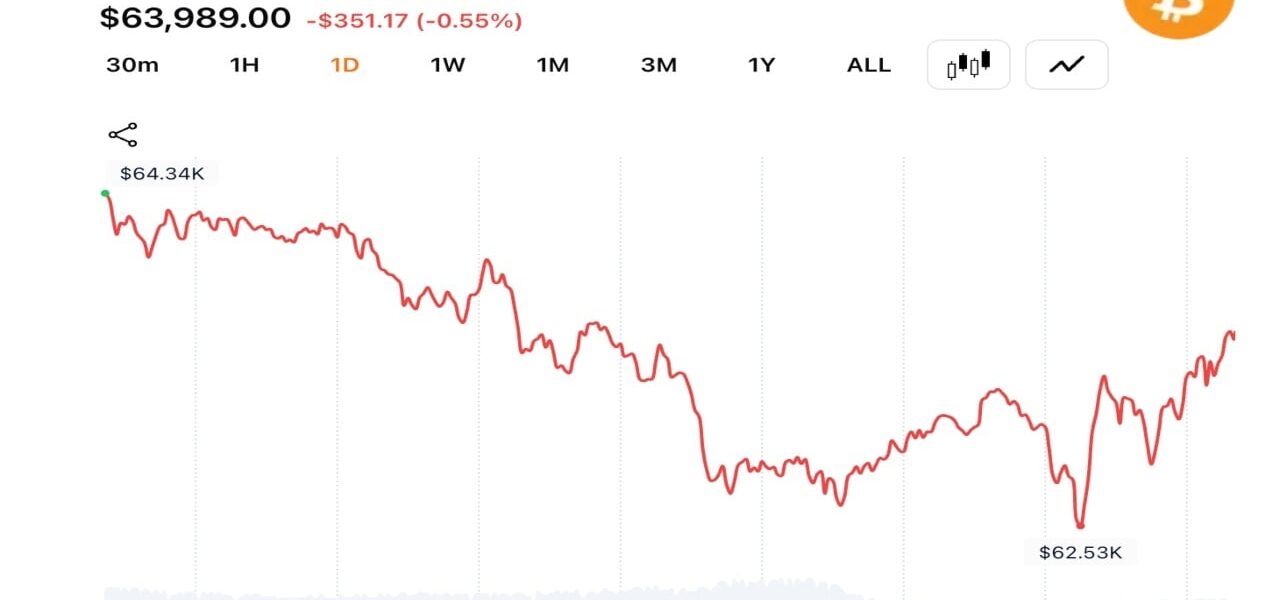
Bitcoin trended lower for a second consecutive day as the bullish sentiment sparked by better-than-expected U.S. inflation data began to fade. After recovering from a brief sell-off to edge toward $64,500 Thursday afternoon, the cryptocurrency struggled to defend the $64,000 threshold. Market data show bitcoin slipped below $64,000 shortly after 6:30 p.m. July 17, continuing its downward trajectory until hitting a session low of $62,732 at 2:20 a.m. Friday.
Following a brief consolidation above $62,750, a tentative reversal stalled at $63,300. A sharp wave of selling then sent the asset tumbling to an intraday low of $62,470 around 9:45 a.m. EDT. However, it reclaimed the $63,300 level less than an hour later. At the time of writing (12:56 p.m.), bitcoin was trading slightly under $63,600, representing a 24-hour loss of 1.4%.
The marginal pullback further trimmed bitcoin’s market capitalization from the $1.3 trillion recorded Wednesday, when it briefly surpassed the $65,000 mark. The downturn also dragged the aggregate crypto market capitalization 1.8% lower to approximately $2.26 trillion.
The bearish tone extended to global equities, which pulled back sharply. The tech-heavy Nasdaq and global technology indices bore the brunt of the damage, driven primarily by a sell-off of artificial intelligence hardware stocks as well as the ongoing military conflict in the Middle East. Unconfirmed reports of damage to Iranian civilian infrastructure on Friday fueled concerns that the conflict has entered a more volatile phase.
The geopolitical escalation pushed the U.S. crude benchmark, West Texas Intermediate (WTI), above $82 per barrel, while Brent crude surged past $87.
Still, some market observers remain unconvinced that geopolitical friction is the sole catalyst for the downturn. While the recent inflation data brought temporary relief, analysts assert that macro sentiment remains weighed down by fears that a resilient economy will force the Federal Reserve to keep interest rates higher for longer — or potentially execute another quarter-point hike by year-end. Surging mortgage rates, which recently hit fresh annual highs, have compounded these monetary tightening fears.
Smart Money Remains ‘Risk-On’
A similar view is shared by Nicolai Sondergaard, a research analyst at Nansen, who noted that bitcoin traded at $63,000 pre-consumer price index (CPI) data release, rallied to $65,100, and only retreated to $62,837 following news of escalation in the Middle East. Sondergaard pointed to wrapped bitcoin (WBTC) on-chain metrics to back up the thesis.
“The WBTC flow data shows the shock registered: net outflows hit -18.3 BTC in the strike hour, then reverted to a post-shock average of +0.67 BTC per hour, meaning buyers returned within the same session,” Sondergaard explained. “Smart money long/short ratios are running at 1.58 with zero stablecoin rotation in the 24-hour window, and seven-day inflows are concentrated in liquid staking, DeFi lending, and DEX protocols — risk-on sector allocation, not defensive positioning. Retail sits at 1.79 long/short, slightly more aggressive but directionally aligned with smart money.”
Sondergaard added that a funding rate of 0.0011 alongside a z-score of 0.14 indicates that leveraged long positioning is not crowded enough to trigger a major liquidation cascade. Previous geopolitical escalations in the region have followed an identical pattern: a short-duration flush followed by steady accumulation.
“The inflation and liquidity channel is doing the structural work here,” Sondergaard concluded.