
Key Takeaways
- Smarter Web repaid $11.7M on July 23 after selling 177.89 bitcoin early.
- Strategy sold 3,620 bitcoin during 2026 as treasury financing conditions tightened.
- Satsuma approved selling 668 bitcoin, while Smarter Web still holds 2,700 BTC.
Early Repayment Funded With Bitcoin Sale
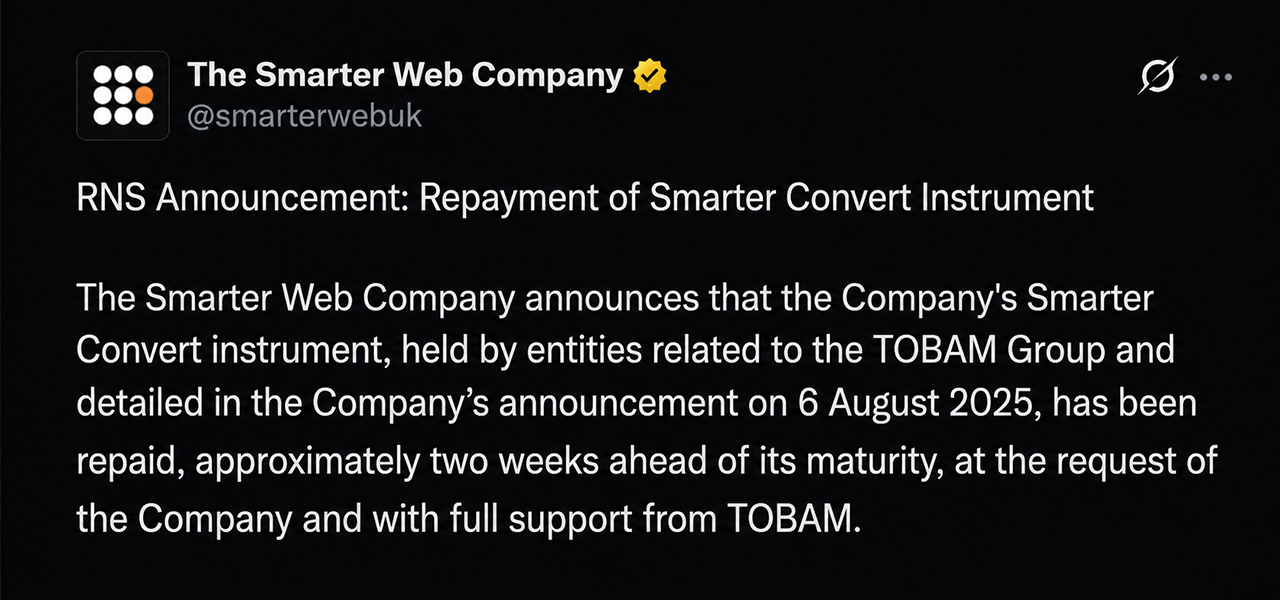
The London-listed company disclosed on Thursday that it repaid $11,698,540 owed under its Smarter Convert instrument held by entities related to TOBAM, a structure first announced in August 2025. The repayment was funded by selling 177.8909127 bitcoin at an average price of $65,762 per coin, representing all of the bitcoin originally acquired through the subscription proceeds.
The agreement originally required at least 98% of the proceeds to be invested in bitcoin, but Smarter Web deployed 100% into the cryptocurrency. Under the terms of the arrangement, the company therefore repaid the full amount using the bitcoin purchased with those funds.
Share Dilution Removed From the Capital Structure
The repayment also eliminated the potential issuance of 7,718,551 ordinary shares tied to the convertible instrument. Smarter Web explained that those shares, along with the 177.89 bitcoin sold to fund repayment, have been removed from its fully diluted bitcoin treasury analytics. Following the transaction, the company continues to hold 2,700 bitcoin, leaving it as the world’s 28th largest public corporate bitcoin holder.
Chief Executive Andrew Webley said the financing structure helped strengthen the company’s balance sheet during the early stages of its bitcoin treasury strategy, but no longer fits its capital allocation priorities. He added that while convertible instruments remain a possible financing tool, the company does not currently consider them the appropriate solution for Smarter Web.
Treasury Companies Increasingly Turning Into Sellers
The transaction arrives as several digital asset treasury (DAT) companies have departed from strategies centered on accumulating bitcoin without reducing holdings.
Earlier this year, Strategy ended its long-standing policy against selling bitcoin. The company first disposed of 32 bitcoin in May as part of a tax-loss harvesting strategy before selling another 3,588 bitcoin across June and July to help fund preferred stock distributions and rebuild cash reserves.
Satsuma Technology also recently abandoned its treasury strategy altogether. Shareholders approved a plan to liquidate the company, sell its remaining 668 bitcoin, settle liabilities, and distribute the remaining proceeds to investors after its stock lost more than 99% from its peak and the business struggled under declining asset values.
A Difficult Year for Digital Asset Treasury Firms
The broader treasury company sector has faced mounting pressure throughout 2026 as bitcoin prices remained well below many companies’ average acquisition costs. Businesses that relied on issuing stock above net asset value or raising capital through convertible securities have found financing conditions more difficult as equity valuations weakened.
Those challenges have exposed structural differences between owning bitcoin directly and investing through publicly traded treasury companies. When corporate shares trade at steep discounts to the value of their underlying bitcoin holdings, issuing additional equity becomes less attractive while debt obligations and operating expenses continue to weigh on balance sheets.
Unlike Satsuma, however, Smarter Web is not winding down its treasury strategy. Instead, the company characterized the repayment as a change in financing rather than a retreat from bitcoin. It continues accepting bitcoin as payment for its web design and digital marketing services and maintains bitcoin as a central component of its treasury policy.
The early retirement of the TOBAM instrument removes a future source of shareholder dilution while simplifying the company’s capital structure. Even after selling nearly 178 bitcoin, Smarter Web remains among the largest public corporate holders of the cryptocurrency, signaling that it is adjusting how it finances its treasury strategy rather than abandoning it altogether.