
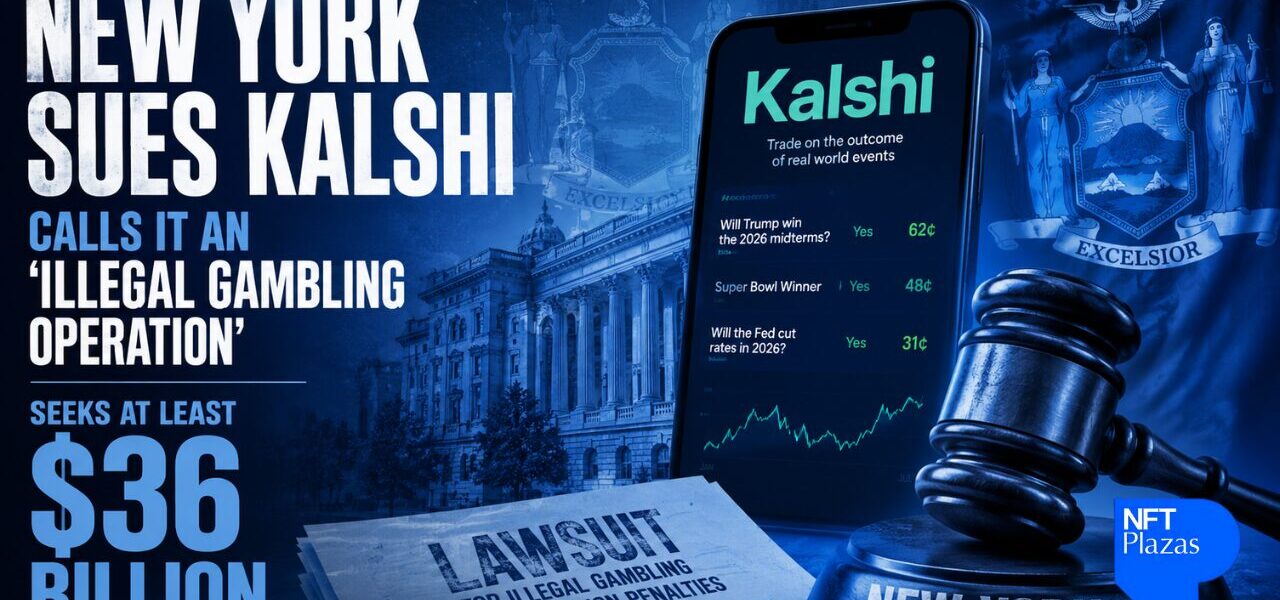
New York Sues Kalshi, Calls Prediction Market an ‘Illegal Gambling Operation,’ Seeks $36 Billion
New York has filed a sweeping lawsuit against prediction market platform Kalshi, accusing the company of operating an illegal gambling business and seeking penalties that could total at least $36 billion.
The lawsuit, filed on July 31 by New York Attorney General Letitia James and backed by Governor Kathy Hochul, argues that Kalshi has been offering event contracts that violate the state’s gambling laws. Officials are asking the court to permanently block the company from operating in New York, require it to return funds to users, surrender alleged unlawful profits, and pay billions of dollars in civil penalties.
The case significantly escalates the legal battle over prediction markets in the United States, where states and federal regulators remain divided over whether these platforms should be regulated as gambling businesses or federally supervised financial exchanges.

New York sues Kalshi, claims it is ‘illegal gambling operation’
New York says Kalshi is offering illegal gambling
According to the complaint, Kalshi allows users to trade contracts tied to uncertain events, including sports, elections, and cultural outcomes, without obtaining a license from the New York State Gaming Commission.
State officials argue that regardless of how Kalshi markets its products, they satisfy New York’s legal definition of gambling because users wager money on events beyond their control.
Attorney General Letitia James said the company’s branding does not change the underlying nature of its business.
“No matter what they call themselves, prediction markets like Kalshi are gambling platforms, plain and simple,” James said in a statement announcing the lawsuit.
Governor Kathy Hochul echoed that position, saying New York’s gambling laws are designed to protect consumers, combat gambling addiction, generate tax revenue for public services, and ensure all operators compete under the same rules.
The lawsuit also claims Kalshi has avoided tax obligations imposed on licensed casinos and sportsbooks operating within the state.
Another allegation centers on age restrictions. New York argues Kalshi allows individuals aged 18 to 20 to participate on the platform, while online sports betting in the state is restricted to those 21 and older. Officials contend this exposes younger users to financial harm and increased risks of gambling addiction.
State seeks at least $36 billion
Beyond requesting a permanent injunction, New York is pursuing substantial financial penalties against the company.
The state wants Kalshi to reimburse users who traded on the platform, forfeit profits allegedly earned through illegal operations, and pay civil penalties equal to three times those profits. It is also seeking an additional $100,000 fine for every event contract offered in violation of state law.
Based on preliminary estimates, New York believes those penalties could exceed $36 billion, although the total could change following a full audit of the company’s activities.
The enormous figure underscores how aggressively the state intends to challenge prediction markets that operate outside its gaming regulatory framework.
Kalshi says states cannot regulate federally licensed exchanges
Kalshi swiftly rejected the allegations, arguing that it operates as a federally regulated financial exchange rather than a gambling platform.
“It’s sad to see this type of political theater from the leadership in our own state,” a company spokesperson said. “States can’t just shut down a federally licensed exchange.“
The company maintains that its event contracts are financial derivatives regulated by the U.S. Commodity Futures Trading Commission (CFTC), meaning individual states cannot classify them as illegal gambling.
Brian Quintenz, a Kalshi board member, described the lawsuit as an unprecedented attempt to eliminate prediction markets altogether rather than resolve legitimate regulatory questions.
The dispute reflects a broader legal debate over whether event contracts should fall under federal commodities law or state gambling statutes.
Federal and state regulators clash
The lawsuit comes amid an intensifying jurisdictional battle between New York and the CFTC.
Just before New York announced its lawsuit, the CFTC asked a federal court to block the state from taking civil or criminal enforcement actions against Kalshi and other prediction market platforms registered with the agency.
The commission argues that event contracts fall under federal commodities regulation and should not be subject to separate state gambling laws. Earlier this year, the CFTC also sued New York, seeking a permanent injunction preventing the state from enforcing its gambling laws against CFTC-regulated exchanges.
However, Kalshi recently suffered a setback when a federal judge in New York denied the company’s request for a preliminary injunction that would have prevented the state’s Gaming Commission from enforcing a cease-and-desist order. The judge later rejected another request for an injunction pending appeal, allowing New York’s enforcement efforts to continue.
Pressure grows nationwide
New York is only the latest state to challenge Kalshi’s operations as prediction markets continue expanding across the U.S.
Last month, a Michigan judge issued a temporary order blocking Kalshi from offering sports-related event contracts. Washington state followed with similar action, arguing the company’s products constitute illegal gambling under state law.
Minnesota has taken a different approach, with a judge temporarily allowing both Kalshi and rival prediction market platform Polymarket to continue operating while litigation proceeds.
The broader regulatory debate is also gaining momentum at the national level. Earlier this week, attorneys general from 44 U.S. states submitted comments arguing that the CFTC lacks authority to regulate sports-related event contracts, insisting those products should remain under state gambling oversight.
Traditional gaming operators have also sided with New York. The American Gaming Association welcomed the lawsuit, saying it helps protect consumers, preserve jobs supported by the regulated gaming industry, and uphold existing gambling laws.
Despite mounting legal challenges, Kalshi remains the world’s largest prediction market platform by trading volume. In June 2026, the exchange recorded approximately $33 billion in trading volume, more than double rival Polymarket’s $13.95 billion.

Trading volume comparison between Kalshi and Polymarket on Aug 02, 2026 (Source: The Block)
With multiple lawsuits now unfolding across the country and regulators continuing to dispute who has authority over prediction markets, New York’s case could become one of the most consequential legal tests yet for the industry’s future in the United States.